Skip to content

News & Events

UW researchers develop a stretchable, wearable device that lights up an LED using only the warmth of your skin

One of the drawbacks of fitness trackers and other wearable devices is that their batteries eventually run out of juice. But what if in the future, wearable technology could use body heat to power itself?

UW researchers have developed a flexible, durable electronic prototype that can harvest energy from body heat and turn it into electricity that can be used to power small electronics, such as batteries, sensors or LEDs. This device is also resilient — it still functions even after being pierced several times and then stretched 2,000 times.

Winners announced for the 2024 Nanotechnology Entrepreneurship Challenge

The National Center for Earth and Environmental Nanotechnology Infrastructure (NanoEarth) hosted the tenth annual NanoTechnology Entrepreneurship Challenge (NTEC) on April 30th. This year, 15 teams competed from seven separate sites, incorporating 18 students. The Northwest Nanotechnology Infrastructure (NNI) supported one team. The NNI Team was led by student Saowaluk Soonthornkit, researching “Durable Double Perovskite SrColrO3 Electrocatalyst for Acidic Media Water Electrolyzer”. Zhenxing Feng, Ph.D, Associate Professor at Oregon State University, served as the team mentor.

UW researchers find electrons uniting into entities with fractions of electric charge without a magnetic field

Despite 127 years of being studied, electrons are still surprising researchers. A UW-led team including NanoES members Matthew Yankowitz and Xiaodong Xu, found electrons behaving like quasiparticles with a fractional charge in a unique setup, a first without a magnetic field.

NanoES announces 2024 Northwest Nanotechnology Seed Grant awardees

The UW Institute for Nano-engineered Systems (NanoES) has awarded three seed grants to UW researchers to use nanotechnology tools to develop new, innovative technologies and devices.  Shijie Cao, professor of pharmaceutics, Ali Sadeghi, postdoctoral scholar in neurological surgery, and Shijing Sun, professor of mechanical engineering will receive up to $10,000 to carry out work in the UW’s Washington Nanofabrication Facility (WNF) and Molecular Analysis Facility (MAF).

Ultra-flat optics for broadband thermal imaging

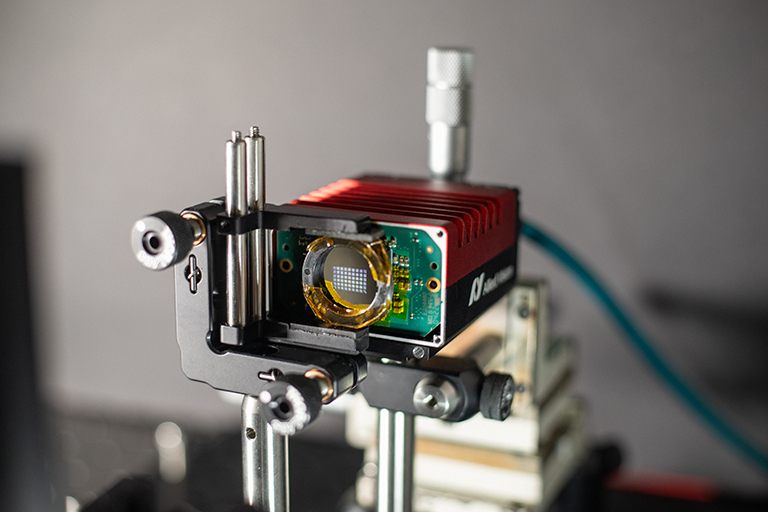
Long-wavelength infrared (LWIR) imaging holds critical significance across many applications, from consumer electronics to defense and national security. It finds applications in night vision, remote sensing, and long-range imaging. However, the conventional refractive lenses employed in these imaging systems are bulky and heavy, which is undesirable for almost all applications. Compounding this issue is the fact that many LWIR refractive lenses are crafted from expensive and limited-supply materials, such as germanium.

UW ECE Assistant Professor Sara Mouradian receives AFOSR YIP award for quantum computing research

UW ECE Assistant Professor Sara Mouradian has been awarded a three-year grant from the Air Force Office of Scientific Research, or AFOSR, through its Young Investigator Program, or YIP. The grant will support work in Mouradian’s Scalable Quantum Research Lab, which aims to build, understand and control trapped ion quantum systems in order to develop useful and practical quantum technologies. Mouradian joins an elite group of investigators as one of only 48 scientists and engineers from across the nation that have been awarded a 2024 AFOSR YIP grant. These individuals have each demonstrated exceptional ability and promise for conducting basic research relevant to the U.S. Air Force and national defense.

CEI ANNOUNCES COLLABORATIVE SEED GRANTS

The University of Washington’s Clean Energy Institute has awarded Collaborative Seed Grants to three teams of UW faculty to enable their pursuit of center-scale funding for transformative clean energy research. Collaborative Seed Grants provide UW scholars with up to $200,000 to explore novel, high-risk/high-reward research topics while seeding new collaborations in research and education that significantly increase the prospects for future extramural support.