June 25, 2026
A University of Washington course is using virtual reality modules to trainstudents for in-demand semiconductor jobs.Electrical & Computer Engineering Associate Professor Tai-Chang Chen adopted the Cornell NanoScale Facility (CNF) Virtual Reality (VR) educational platform for his Devices and Circuits 1 (EE 331) course this spring to offer students the job skills needed to fill the growing semiconductor technical workforce gap.
Semiconductor chips control electricity in just about every piece of modern technology. And since they are even smaller than microscopic airborne particles that can cause device failures, their production requires a controlled environment that only a cleanroom can provide.
Based on projections from the Semiconductor Industry Association, 67,000 semiconductor jobs in the United States will be unfilled by 2030 — that’s 58% of roles spanning across manufacturing and design. The CNF VR educational models make it possible to scale cleanroom training and support workforce development goals by reaching significantly more learners.
Students in EE331 are immersed in the cleanroom-user experience, which includes simulated face-to-face interactions with CNF equipment and staff. The course was equipped with eight Meta Quest 3 headsets (one per student, per lab section), along with licensed access to CNF’s library of immersive cleanroom modules, including:
- Cleanroom Gowning
- Cleanroom Safety
- a four-part photolithography series
- Micron Technology’s Careers in a High-Tech World VR
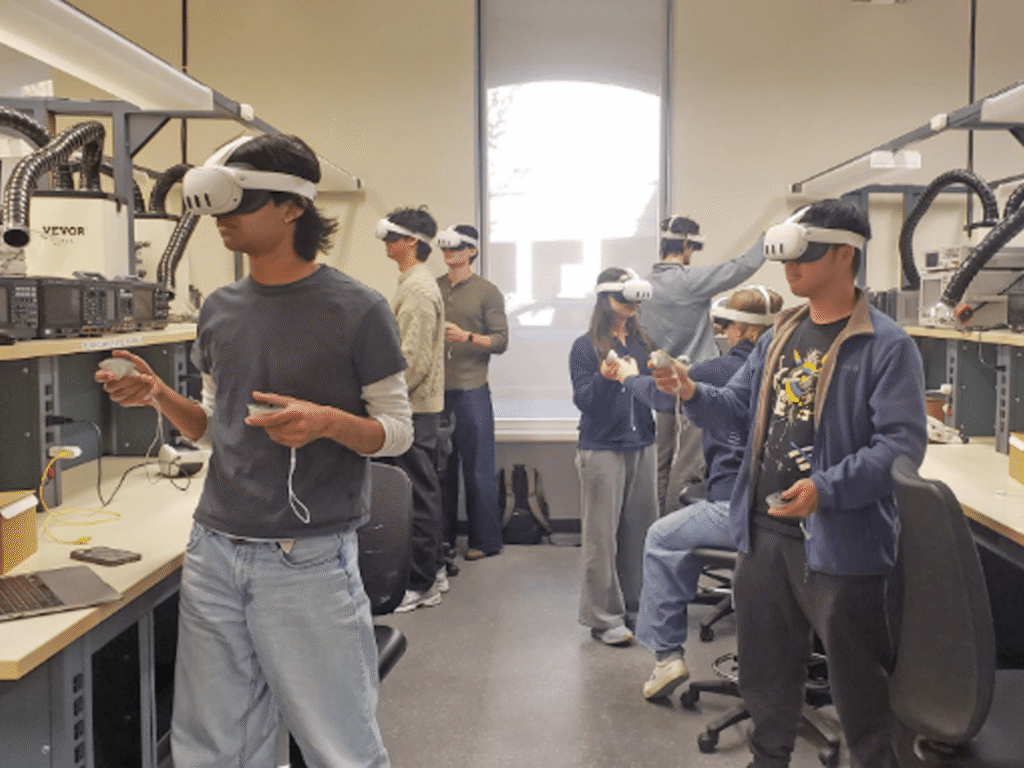
Access to the platform was made possible by the CNF VR Early Adopters Program and supported by funding from the U.S.-Japan University Partnership for Workforce Advancement and Research & Development in Semiconductors (UPWARDS) for the Future Network — an international partnership designed to develop semiconductor talent — for $10K per year for two years, with the second course being offered in 2027.
“Incorporating CNF VR educational modules in the classroom offers UW students a unique edge in developing in-demand skills in the microelectronic and nanotechnology fields,” said Chen. “This opportunity highlights UW’s commitment to innovation, along with its role in strengthening the semiconductor industry as an UPWARDS for the Future Network partner.”
UW’s on-campus cleanroom is housed within the Washington Nanofabrication Facility (WNF) in Fluke Hall. WNF Acting Director Darick Baker worked with CNF and UPWARDS to enroll UW in the beta-test deployment and prepared the headsets for students.
With a potential shortage in a skilled cleanroom workforce in the next five to ten years, “many additional cleanroom workers are needed, but very few students are familiar with what semiconductor manufacturing requires,” noted Baker. “The CNF VR educational modules allow WNF and UW to introduce more students to the cleanroom environment,” noted Baker.
Students complete the modules in VR prior to their hands-on lab sessions, allowing them to enter the WNF better prepared and able to make more productive use of limited lab time. Early observations suggest that the VR platform meaningfully extends the reach of experiential learning in the EE331 course.
“Immersive VR content empowers students,” said Chen. “These innovative modules enhance the lab experience and provide students with both exposure and confidence to master cleanroom protocols — and ultimately contribute to filling the needs that come with the rapid growth of the semiconductor field.”
Additionally, Chen is exploring further integration through a planned UW–Japan study-abroad fabrication course developed in partnership with member institutions of the UPWARDS for the Future Network. In 2023, Micron and Tokyo Electron Limited (TEL) launched the UPWARDS for the Future Network alongside university partners. This partnership cultivates a more diverse, robust and highly skilled talent pipeline for the semiconductor workforce — and drives emerging research while increasing the pipeline of students studying a semiconductor curr